
The phone calls all start the same way. "I wiped the wall last month and it's back again." Black-dot mould at the AC corner, dark fuzz on the ceiling above the bathroom door, a musty press-sniff on the master mattress — these aren't separate problems. They're symptoms of the same root cause: Puchong's ambient humidity sits between 75% and 85% almost every day of the year, and a sealed condo unit traps it.
Wiping mould away without fixing the moisture conditions just resets the clock. Five habits — applied consistently, not just when guests are coming — actually break the cycle. Here's the framework we use with hundreds of Puchong households on our recurring schedule.
Why Puchong Condos Grow Mould Faster Than KL Landed Homes
Three local realities stack up. First, lift-shaft thermals — the elevator core of a Puchong high-rise pulls moist air upward, and units adjacent to it record 3–5% RH higher than units on the opposite side of the same floor. Bandar Puteri Puchong Phase 4 and the Setia Walk towers are notorious for this on the lower-numbered stack.
Second, AC condensation feedback loops. A split-unit running in cooling mode pulls warm humid room air across a cold coil, condenses water into a drain tray, and exits via a pipe. When the tray is dusty or the pipe partially blocked, standing water sits in the tray and evaporates back into the room between cooling cycles — creating a micro-humidity spike at exactly the wrong time.
Third, dust mite amplification. Mites thrive above 70% RH and their waste particles distribute mould spores. A 900 sqft Bandar Kinrara condo with carpeted bedrooms and an untreated mattress can move spores from a single bathroom corner to every soft furnishing in the unit within ten days.
Most Puchong condo mould problems come back because the underlying humidity isn't being managed — only the surface growth is being wiped. Combine AC dry mode, daily shower-glass squeegeeing, weekly AC filter washing, monthly mattress airing, and a monsoon-season dehumidifier. Together these keep indoor RH below the 70% threshold where mould cannot sustain colonies.
| Puchong unit type | Typical indoor RH | Mould reappearance window without habits |
|---|---|---|
| High-rise condo (18F+) · Setia Walk, Bandar Puteri | 78–85% | 5–7 weeks |
| Mid-rise condo (5–17F) · Bandar Kinrara, Bukit Puchong | 74–82% | 7–10 weeks |
| Landed terrace · Taman Wawasan, IOI Resort | 68–76% | 10–14 weeks |
Habit 1: Run AC Dry Mode 30 Minutes Daily
Most Daikin, Panasonic and Midea split units sold in Malaysia have a "dry" or "dehumidification" mode — the icon is usually a water-droplet symbol. In dry mode, the compressor runs at reduced capacity while the fan continues circulating air across the cold coil. The unit removes moisture without aggressively cooling the room, using 30–40% less electricity than full cooling mode.
Running dry mode for 30 minutes in the morning — before the day's humidity builds — pulls a 900 sqft condo from 80% to roughly 68–72% RH. That drop is enough to push the unit below the active mould-growth threshold for the rest of the morning. The key is consistency: six days out of seven keeps suppression real. Sporadic use does almost nothing because humidity recovers to baseline within 2–3 hours.
One caveat — if your AC drain tray is dirty or partially blocked, running any mode won't help. Standing condensate just re-evaporates. Combine this with Habit 3 (filter washing) for full effect.
Habit 2: Squeegee Shower Glass Every Single Day
Bathroom surfaces are the fastest mould colonisation sites in any Puchong condo. A standard shower leaves 200–400 ml of water film on glass and tile. Without removal, that water evaporates over the next 2–3 hours, raising local humidity to 90%+ and keeping grout joints wet far past the point of mould germination.
A rubber-bladed squeegee removes roughly 80% of that water in under 90 seconds. Start at the top of the glass, overlap each stroke by 5cm, wipe the blade between passes. The bathroom dries to ambient in 20–30 minutes instead of 2–3 hours — a 70% reduction in cumulative moisture exposure per week.
Keep the squeegee hanging inside the shower, not under the sink. Pair with leaving the bathroom door open for 15 minutes post-shower and running the exhaust fan if one is fitted. In Bandar Kinrara units with internal windowless bathrooms, this is the single most effective mould-prevention action you can take.
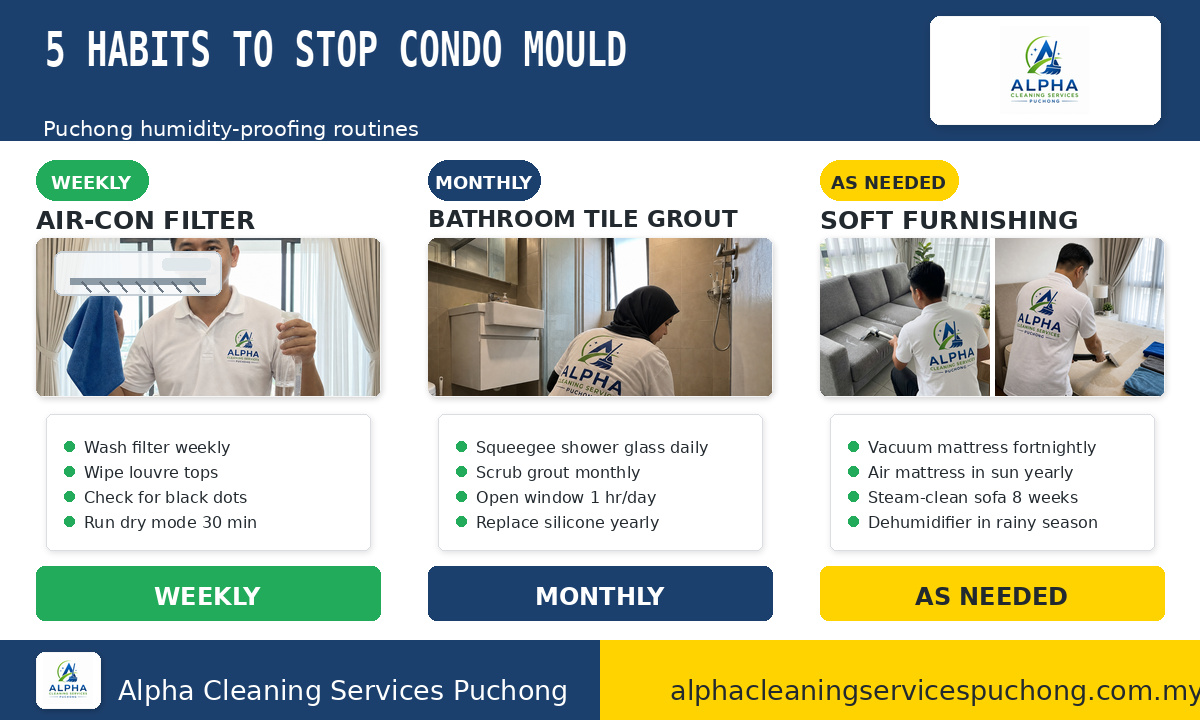
Habit 3: Wash AC Filters Weekly, Wipe Louvres Fortnightly
Clogged AC filters are the most commonly overlooked humidity driver. A dust-loaded filter reduces airflow across the evaporator coil, causing the coil to ice over and release a large water pulse when defrosting — often pooling faster than the drain pipe can clear it. The result is intermittent overflow, which saturates the wall section below the indoor unit and grows persistent mould within three weeks.
Filter washing takes four minutes. Slide the filter out, rinse under tap water until runoff is clear, shake off excess, leave to dry 20 minutes in shade before reinserting. Do this weekly during the October–March monsoon and fortnightly the rest of the year. A clean filter also drops AC electricity consumption by 5–8%.
The louvres themselves — the horizontal slats that direct airflow — collect a thin grey dust film that holds moisture. Wipe with a dry microfibre cloth fortnightly. Don't use wet cloths on louvres; moisture drips into the unit body. For full coil + tray service, book a specialist AC clean every 3–4 months.
Habit 4: Air Out Mattresses + Soft Furnishings Monthly
A double mattress in a closed AC bedroom absorbs 200–500 ml of moisture per night from perspiration and respiration. Over 30 nights, that saturates the foam core and underside fabric — especially memory-foam mattresses, which are denser and slower to release moisture than spring-core. The underside resting on a slatted base or solid platform rarely sees airflow and can stay above 85% RH continuously.
Monthly airing means standing the mattress on its side against a wall near an open window or balcony door for 2–4 hours. Air moves through the foam core and embedded moisture drops by 30–50%. Combine with a monthly HEPA-vacuum to remove dust mites that carry mould spores across the surface. Sofa cushion covers get the same treatment — hung in a ventilated space for 2 hours on the same monthly day.
If your mattress has visible yellowing on the underside, a musty press-sniff, or hasn't been professionally treated in over 12 months, airing alone won't clear established mould. Professional mattress steam extraction is the right reset before returning to monthly airing.
Habit 5: Use A Dehumidifier During Monsoon Season Oct–Mar
The northeast monsoon brings sustained outdoor humidity above 85% RH to Klang Valley from October through March. Even units with good AC discipline and daily squeegeeing creep above 75% indoor because every window opening or door entry pulses saturated air inside. A portable dehumidifier running 10pm–7am holds indoor RH at 58–65% — safe for all surfaces.
A 10-litre-per-day dehumidifier (EuropAce, Midea, RM 350–RM 650 at Aeon or Harvey Norman) is sufficient for a 900 sqft condo. Running cost is RM 25–RM 40 per month at TNB residential rates on eight hours daily. Empty the tank every 24 hours during monsoon months — a full tank stops the unit and leaves humidity uncontrolled overnight.
Position the unit away from walls and curtains for unrestricted intake. For high-rise units above the 20th floor in Setia Walk or Bandar Puteri, where wind exposure makes window seals harder, consider running the dehumidifier year-round at a reduced 4–5 hour daily schedule. Track RH with a RM 20–RM 35 digital hygrometer from Daiso Puchong Parade or Mr DIY at IOI Mall.
When Mould Is Already There — What Alpha Does
If mould has already colonised grout lines, ceiling corners, behind furniture or on soft furnishings, the five habits above will slow regrowth but won't remove existing growth. Active mould needs physical removal with anti-fungal treatment, followed by surface sealing to prevent spore re-germination. Our mould remediation deep-clean covers grout scrubbing with fungicidal solution, ceiling and wall wipe-down, drain tray clearing, and mattress sanitisation in a single session — typically 3–4 hours for a 3-bedroom condo. After remediation, the five habits keep the unit clean long-term. For cost expectations, see our Puchong cleaning price guide.
Get It Cleared Before The Next Monsoon
WhatsApp us photos of the affected areas — quote in 30 minutes, flat ringgit, no surprises.
WhatsApp For Mould Clean Quote