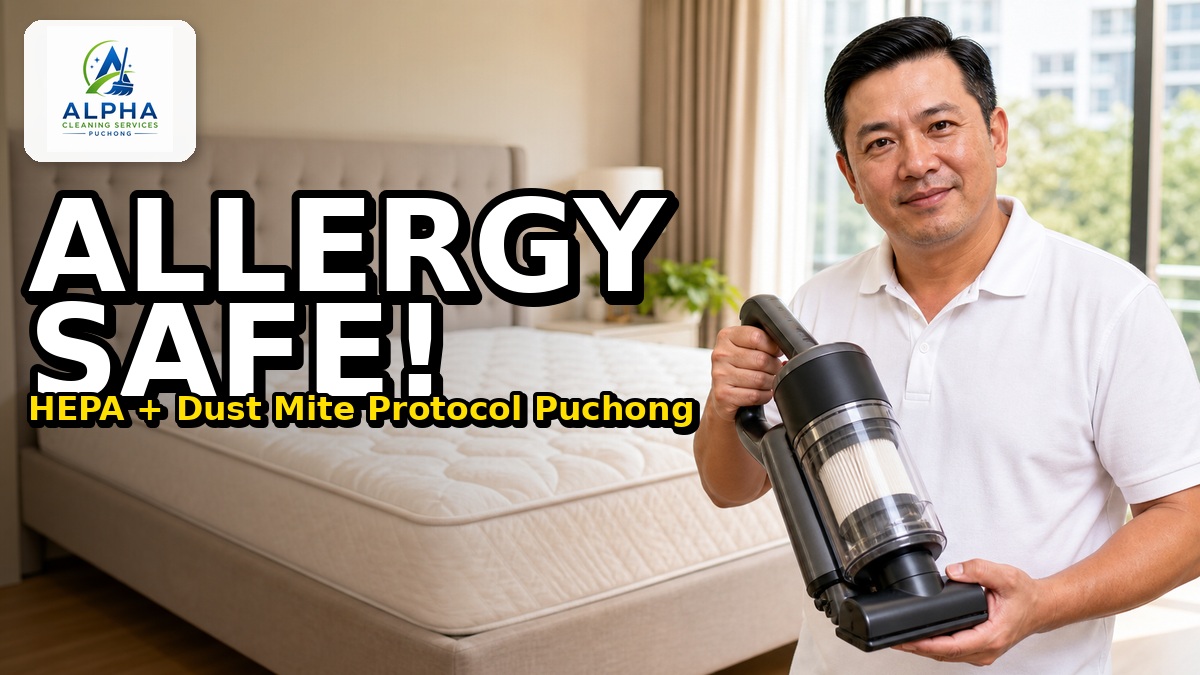
Puchong allergy sufferers face a disadvantage that households in Kuala Lumpur's higher-floor condos and drier northern states don't: ground-level humidity that rarely dips below 70%, combined with densely-packed condo corridors that trap particulate matter. The result is a dust mite load that stays elevated every month of the year — not just during the school holidays when windows stay shut with the AC on.
This guide covers the full protocol: why humidity is the root cause, what a HEPA vacuum actually does differently, the daily and weekly habits that prevent mite colonies from rebuilding, and when a professional deep reset makes more sense than DIY maintenance.
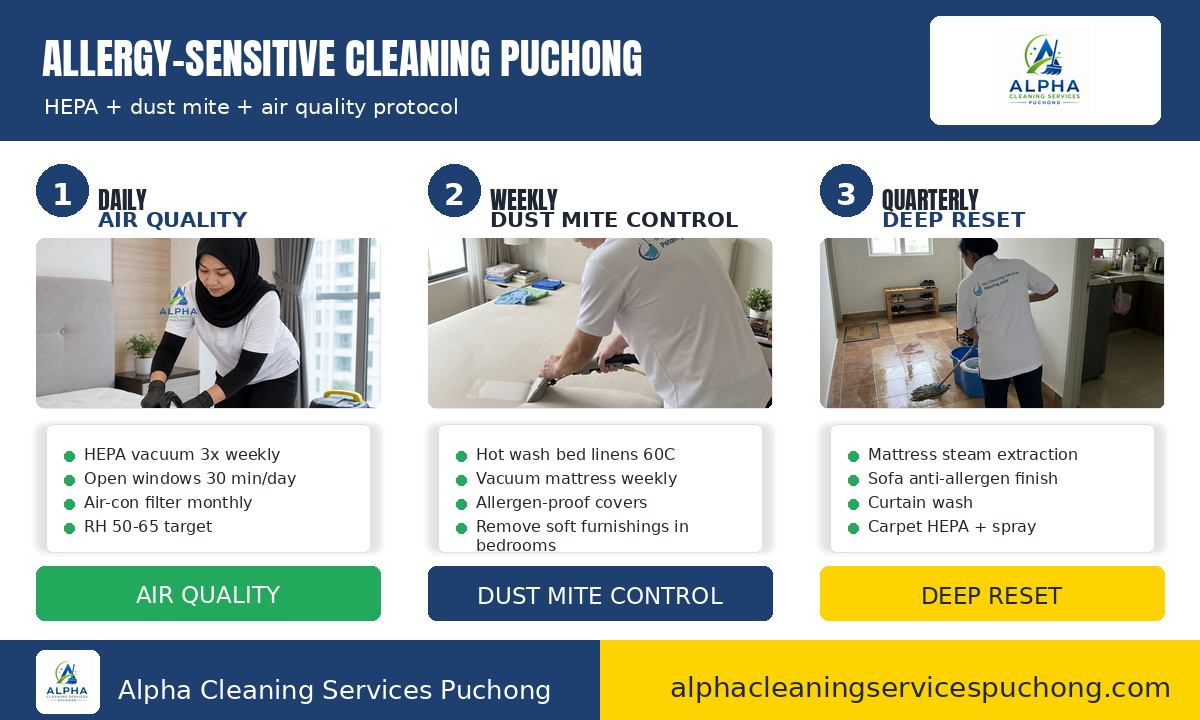
The three actions with the most measurable impact on allergen load are: HEPA-filter vacuuming of all soft surfaces weekly, washing bedding at 60°C or above every 7 days, and keeping indoor relative humidity below 60% via AC dry mode. Everything else in this guide layers on top of those three.
Why Puchong Allergy Rates Run Higher Than Drier States
Klang Valley sits at roughly 3°N latitude with an average annual relative humidity of 82%. Puchong specifically — bordered by the Puchong wetlands and the LDP highway corridor — sees ground-floor and low-rise units hold humidity above 75% for 10–11 months of the year. Dust mites (Dermatophagoides pteronyssinus and D. farinae) require a relative humidity above 50% to survive and above 70% to breed rapidly. Below the 50% line, adult mites desiccate within 24 hours.
That threshold is permanently crossed in almost every Puchong unit that doesn't run dehumidification. Surveys of Malaysian residential units have found mite concentrations of 200–500 mites per gram of mattress dust — five to twelve times higher than the threshold associated with sensitisation in atopic individuals. For a household with one asthmatic or eczema-prone child, this is the primary environmental driver of flare frequency.
Northern Malaysian states like Kedah and Perlis experience distinct dry seasons in January–February that naturally suppress mite populations for 6–8 weeks per year. Puchong gets no such reprieve, which means the control protocol has to be year-round rather than seasonal.
HEPA Vacuum Basics — Filter Rating, When It Matters, Brand Picks
A standard vacuum with a foam or paper filter captures particles down to roughly 10 microns. Dust mite faecal pellets — the primary allergen, not the mites themselves — average 10–40 microns when intact but fragment to 1–5 microns on disturbance. That means a standard vacuum picks up the visible debris while aerosolising the allergen-carrying fragments back into your breathing zone.
A true HEPA filter (H13 or H14 to EN 1822 standard) captures 99.95% of particles at 0.3 microns. The practical effect: the exhaust air from a HEPA vacuum is measurably cleaner than the room air going in. The filter rating to look for on the box is H13 or higher — "HEPA-style" or "HEPA-like" filters do not meet this standard and should be treated as standard filtration.
For Puchong households, the following categories work well at different budgets:
- Corded upright / canister (RM 600–1,400): Miele C3 series, Bosch BGB series. Consistent suction for full-flat coverage. Best for weekly whole-unit passes.
- Cordless stick with HEPA seal (RM 500–1,200): Dyson V12/V15, Dreame L20 Ultra. Convenient for daily sofa and mattress spot passes. Confirm the filter is sealed HEPA, not just HEPA-grade media in an unsealed housing.
- Robot vacuum with HEPA exhaust (RM 800–2,500): Roborock S8 Pro Ultra, Ecovacs Deebot X2. Useful for maintaining floors between weekly full-cleans — not a substitute for mattress and sofa passes.
One practical note: vacuum bags seal the collected dust on disposal; bagless bins release a cloud of fine particles when emptied. If budget allows, a bagged HEPA vacuum is meaningfully better for allergy households than a bagless model, even at a higher price point.
Daily Air Quality Habits — Window Timing, AC Dry Mode, RH Target
Allergen load in a Puchong unit is not just about what's on surfaces — it's about what's suspended in the air column. These daily habits address the airborne fraction.
- Window timing: Puchong outdoor humidity is lowest between 11am–2pm on dry-season days and between 10am–12pm after overnight rain. Opening windows during these windows allows moisture exchange without importing high-humidity air. Avoid opening windows after 4pm when convective humidity rises with afternoon cloud buildup.
- AC dry mode (not cooling mode): Most split-unit ACs sold in Malaysia include a dry mode that runs the compressor intermittently to dehumidify without aggressive cooling. Running dry mode for 1–2 hours in the morning keeps bedroom RH below 60% without the energy cost of continuous cooling. Target indoor RH: 50–60%. A RM 15 hygrometer from any hardware store lets you verify this.
- AC filter cleaning: AC filters coated in dust re-aerosolise particles every time the unit runs. Wash the filter under running water monthly; for households with severe allergy cases, every 3 weeks.
- Doormat protocol: A significant fraction of outdoor allergens enters on shoe soles. A wet-scrub doormat outside and a second dry mat inside cuts transfer by roughly half.
Weekly Dust Mite Control — Hot Wash Linens, Mattress Vacuum, Allergen Covers
The bedroom concentrates allergen exposure: a person spends 6–8 hours per night in direct contact with mattress and pillow surfaces, breathing air from within 30cm of the bedding. Weekly control of this zone is the highest-return single habit in the protocol.
- Wash all bedding at 60°C minimum. Malaysian front-loader washing machines default to 40°C. Dust mites survive 40°C washes and die at 55°C+. Set the machine to 60°C or use a hot-wash programme. If your machine lacks a 60°C setting, a 30-minute tumble dry at high heat after a normal wash achieves the same kill rate.
- Vacuum the mattress surface weekly. Use the upholstery tool on a HEPA vacuum. Work in overlapping rows, both sides if the mattress is flippable. This removes mite faecal matter and shed skin cells (the mite food source) before they penetrate deeper into the foam.
- Allergen-barrier covers on mattress and pillows. Woven microfibre barrier covers (pore size ≤6 microns) prevent mite colonisation of the inner foam. They cost RM 60–180 per mattress depending on size and wash in a standard machine. This is the single most cost-effective intervention for severe allergy households — it creates a washable barrier between the occupant and the mite habitat.
- Weekly sofa cushion vacuum. Fabric sofas are the second-highest mite reservoir after the mattress. See the sofa cleaning page for deep-clean options when the weekly vacuum is insufficient.
Quarterly Deep Reset — Mattress Steam, Sofa Anti-Allergen, Carpet HEPA Pass
Weekly maintenance prevents accumulation; quarterly professional treatment resets any mite population that has established deeper than surface vacuuming reaches.
| Rhythm | Action | DIY or Hire |
|---|---|---|
| Daily | AC dry mode 1–2 hrs; doormat refresh; AC filter check | DIY |
| Weekly | Bedding hot wash at 60°C; HEPA mattress vacuum; sofa cushion vacuum | DIY |
| Monthly | AC filter wash; HEPA full-flat vacuum including curtains and skirting | DIY |
| Quarterly | Mattress steam treatment; sofa anti-allergen shampoo; carpet HEPA extraction pass | Hire |
| Annually | Full deep-clean + upholstery extraction; allergen cover replacement check | Hire |
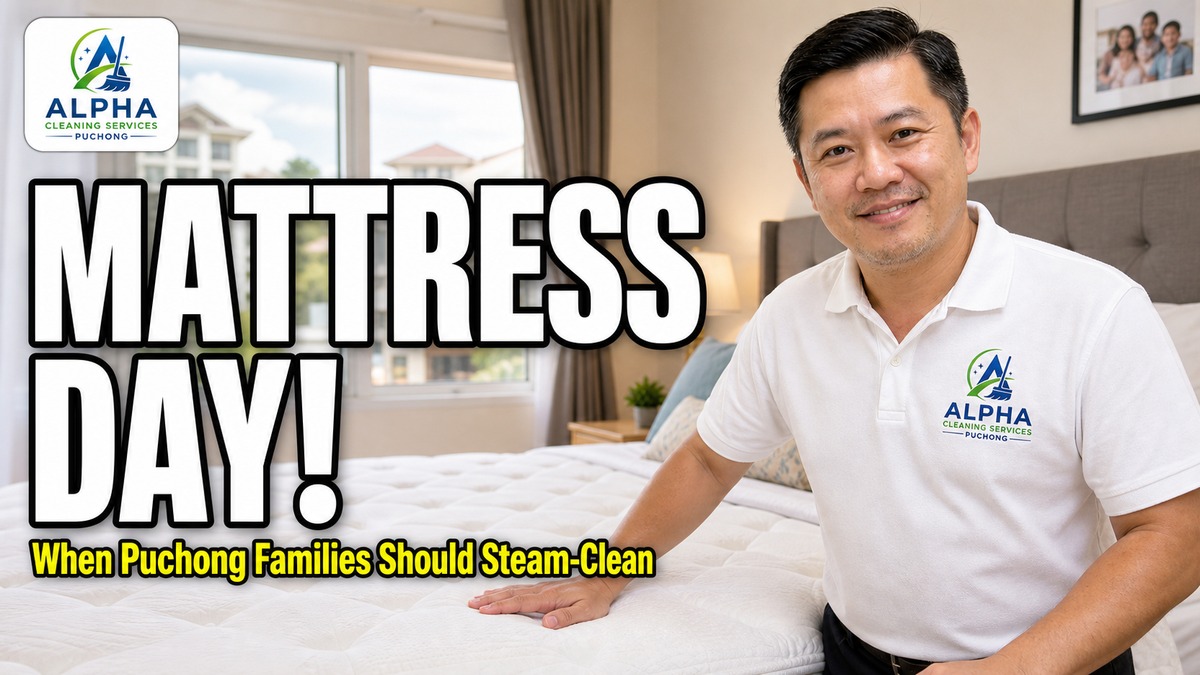
Professional mattress steam cleaning uses a dry-steam injector that reaches 140–160°C at the nozzle — sufficient to kill mites through 2–3cm of foam with a single pass. The moisture content is low enough that the mattress is dry to the touch within 2 hours. Combined with an enzyme-based anti-allergen spray that denatures the Der p1 protein (the primary mite allergen), a quarterly treatment reduces measurable allergen load by 70–90% for approximately 10–12 weeks.
Sofa anti-allergen shampooing uses a low-moisture foam extraction method on fabric upholstery — the same principle as carpet extraction but with lower water volume to protect foam cushion cores. If your sofa is leather or faux leather, allergen load is lower by default; focus quarterly treatment on fabric panels and cushion seams where skin cell debris accumulates.
Carpeted bedrooms in Puchong are the highest-risk floor type for mite load. A quarterly HEPA extraction pass — not a standard shampoo but a hot-water extraction unit with a HEPA exhaust — removes embedded faecal matter from carpet pile that weekly surface vacuuming cannot reach.
When To Hire Professionals For Severe Cases
DIY maintenance is sufficient for most Puchong households running an ongoing protocol. There are four situations where professional intervention is warranted regardless of how consistent the weekly routine has been:
- New diagnosis of asthma or dust mite allergy in a household member. A professional baseline deep reset — mattress, sofa, carpet, full HEPA clean — gives the DIY protocol a lower starting mite load to maintain rather than trying to reduce an established colony through weekly passes alone.
- Post-renovation or post-tenancy units. Construction dust, vacated unit accumulation, and disturbed floor finishes all spike airborne allergen counts. A professional HEPA clean before moving in is meaningfully more effective than cleaning after furniture is in place.
- Consistent allergy symptoms despite ongoing DIY protocol. If a household member continues to experience symptoms 6–8 weeks after starting the weekly routine, a professional allergen assessment followed by targeted treatment (often the sofa or an overlooked carpet section) typically identifies the residual source.
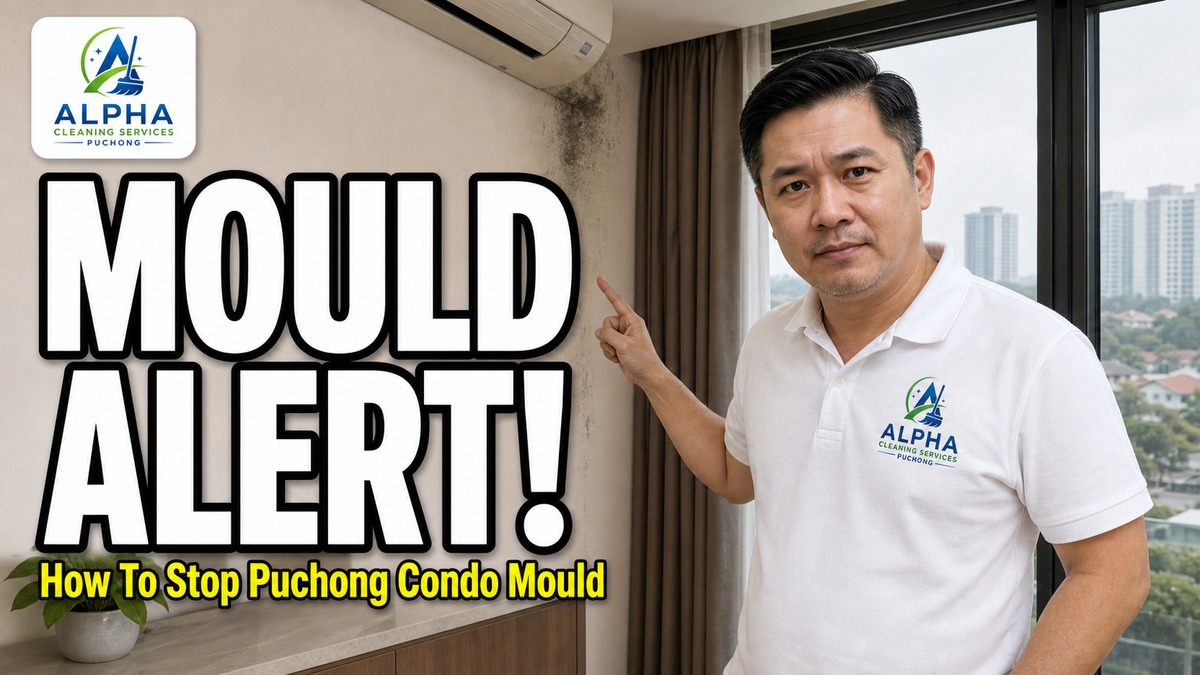
- Units with visible mould growth. Mould spores and dust mite allergens present simultaneously require different treatment protocols. See the Puchong humidity and mould prevention guide for the mould-specific approach before combining treatments.
For households with a diagnosed allergy sufferer, the full Alpha allergy-sensitive clean covers mattress steam, sofa extraction, carpet HEPA pass and a whole-unit HEPA vacuum in one appointment. The team uses fragrance-free, enzyme-based products throughout — no synthetic fragrances that can themselves trigger airway irritation in sensitised individuals.
Ready For An Allergy-Sensitive Deep Reset?
Send your unit size and the surfaces you want treated — we'll quote mattress steam, sofa extraction and HEPA clean as a bundle. Fragrance-free products, HEPA equipment throughout.
WhatsApp For A Quote