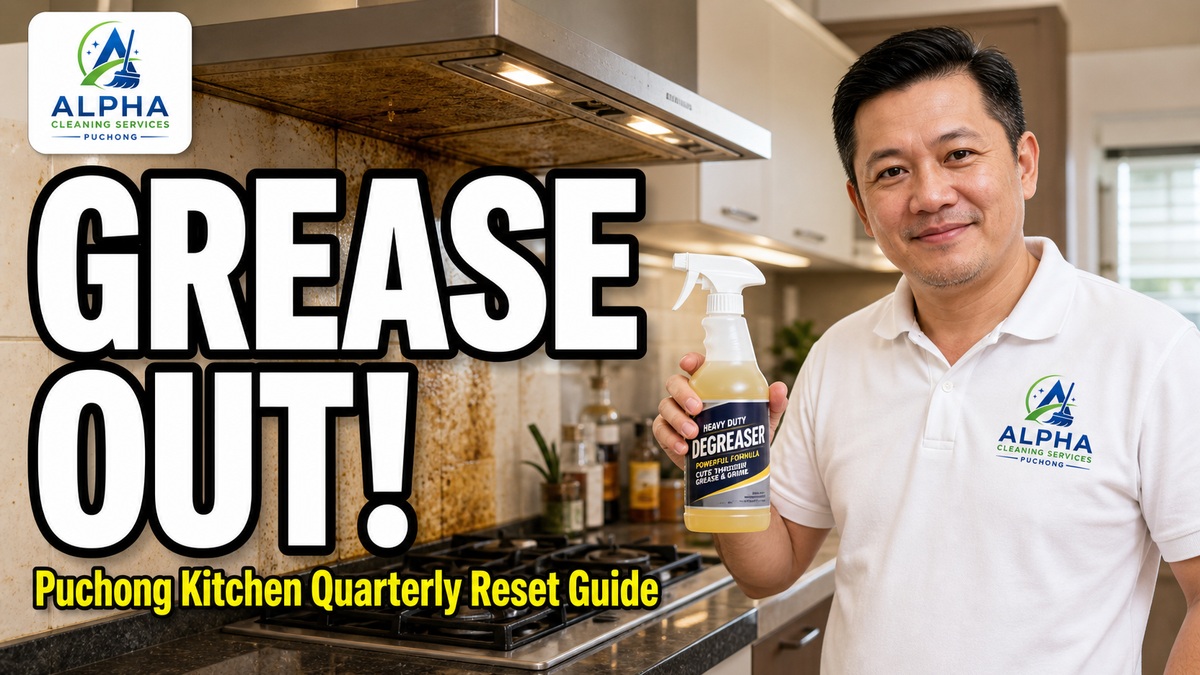
Walk into any Puchong kitchen that cooks Malaysian food daily and you will find the same thing: a thin amber glaze on cabinet fronts above the hob, range hood mesh so clogged it barely draws air, and splashback grout that has shifted from white to beige. None of this is about hygiene failure — it is just the physics of wok cooking with high BTU gas flames and palm-oil-based fats that polymerise at temperatures a Western gas hob rarely reaches.
This guide covers why the build-up happens faster here than in European kitchens, what a sensible weekly maintenance habit looks like, exactly what a quarterly deep reset involves, the trigger events that force an early reset, and the tools and products that actually work on Malaysian-kitchen grease — including where to buy them at Tesco Puchong.
Malaysian wok cooking deposits polymerised grease 3–4× faster than standard hob cooking. A quarterly kitchen reset — range hood mesh soak, inside cabinet wipe, fridge gasket clean, oven degrease — prevents permanent staining and keeps your extractor working at full draw. DIY cost: RM 30–60 in product. Professional reset: RM 180–320 depending on kitchen size. Trigger an early reset after Hari Raya cooking, a 2-month travel absence, or any post-renovation dust settle.
Why Puchong Kitchens Accumulate Grease Faster Than Western Kitchens
The short answer is temperature and fat type. A Malaysian gas hob running a wok at full flame reaches 280–320°C at the pan surface. At those temperatures, cooking oil — particularly palm oil and coconut oil which are standard in Malaysian households — breaks into fine aerosol droplets that float well beyond the cooking zone before condensing on every cold surface they touch.
European induction or low-BTU gas cooking stays under 180°C for most tasks. The aerosolisation is far lower. Add the fact that Malaysian cooking involves frequent high-heat frying — goreng pisang, ayam goreng, sambal tumis — and you are generating grease aerosol multiple times per day, seven days a week. The range hood captures some of it. The rest lands on cabinet fronts, the ceiling above the hob, light fittings, and the tops of appliances.
Puchong's humidity compounds the problem. Condensation makes grease stickier. A layer that might dust off in a dry climate turns into a tenacious film here within weeks, and once it has been through two or three more cooking sessions it is effectively baked on. That is why surface wiping after cooking — while good practice — only removes the fresh top layer. The older baked layer underneath stays put and keeps accumulating.
Weekly Maintenance: Cabinet Door Fronts, Sink, and Drain Trap
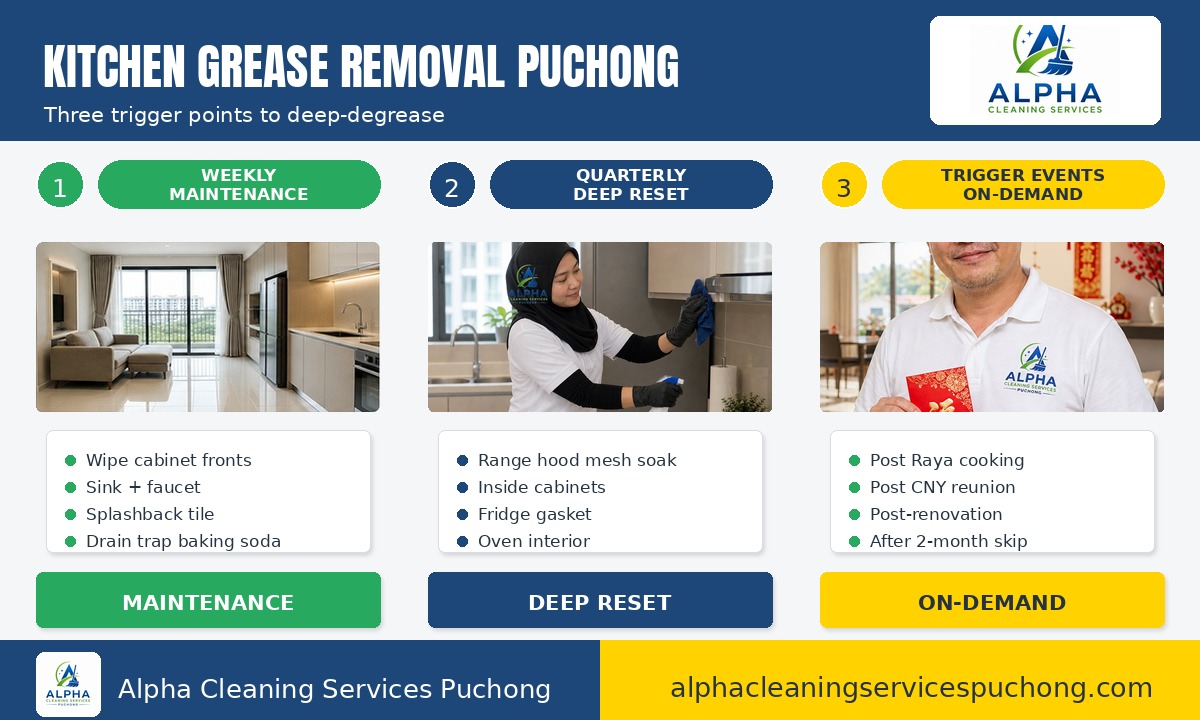
Weekly maintenance does not prevent quarterly resets — it just slows the build-up rate so quarterly is enough. Three surfaces matter most on a weekly cycle.
Cabinet Door Fronts Above the Hob
These catch the densest aerosol. A quick wipe with a damp microfibre cloth and a spray of Mr Muscle Kitchen (available at Tesco Puchong IOI Mall) once a week keeps fresh grease from polymerising. The key is to wipe in one direction — not circular — so you are lifting the film rather than spreading it. Do not use abrasive pads on laminate cabinet faces; they micro-scratch and the scratches trap grease permanently.
Sink and Tap Base
Puchong water has moderate hardness. Limescale and grease combine around the tap base and drain collar into a grey paste that is harder to remove the longer it sits. Weekly scrub with CIF Cream on the stainless steel sink takes 90 seconds and prevents the paste from setting. CIF Cream is non-abrasive on steel but effective enough to cut through the combined limescale-grease deposit.
Drain Trap
Pour boiling water down the kitchen sink drain weekly after washing up. This is not about hygiene — it is about keeping the grease in the trap liquid rather than solid. A solidified grease trap smells bad and slows drainage. A weekly hot flush costs nothing and takes ten seconds. Every two months, disassemble the U-bend and rinse it under the tap. It takes five minutes and prevents a RM 150 plumber call-out for a blocked drain.
Quarterly Deep Reset: Range Hood Mesh, Inside Cabinets, Fridge Gasket, Oven
A quarterly reset is the task that actually removes baked grease — the layer that weekly wiping cannot shift. Budget two to three hours for a standard Puchong condo kitchen. Here is the sequence that works.
Range Hood Mesh Soak
Remove the aluminium mesh filters (most Puchong range hoods have 1–3 panels) and submerge them in a sink filled with near-boiling water and 3–4 tablespoons of caustic soda or a purpose degreaser like Cif Power & Shine Kitchen Spray. Let them soak for 20–30 minutes. The grease will loosen visibly — you will see it floating off. Rinse under running water, scrub any remaining deposits with an old toothbrush, and leave to air-dry before refitting. Do not use a dishwasher; it strips the anodising on aluminium mesh. A blocked range hood draws as little as 40% of its rated airflow, which means the grease that should exit through the duct is recirculating into your kitchen instead.
Inside Cabinets
Empty the cabinets above and flanking the hob and wipe inside surfaces with diluted white vinegar (1:3 ratio with water) or Mr Muscle Kitchen spray. Pay particular attention to the inside top surface of each cabinet — grease aerosol enters through every gap and settles on the top interior. This is the surface most DIY cleaners skip, and it is usually the greasiest. Re-line with fresh shelf liner paper after cleaning.
Fridge Gasket
The rubber seal around the fridge door accumulates a combination of grease, food residue and mould — particularly in Malaysian humidity. Wipe the gasket with a cloth dampened in white vinegar, then push a thin cloth into the fold using a butter knife to clean the interior channel. A deteriorating gasket costs RM 80–150 to replace; cleaning it quarterly extends life significantly and prevents the musty smell that transfers to food.
Oven Interior
If you have a built-in oven, quarterly is the minimum clean cycle. Remove the racks and soak in the same degreaser bath as the range hood mesh. Spray the oven interior with Easy-Off Oven Cleaner or Mr Muscle Oven and leave for the dwell time on the label (usually 30–60 minutes for heavy grease). Do not rush the dwell — wiping before the product has finished breaking down the polymerised fat is the most common reason DIY oven cleaning fails. Wipe out, rinse racks, refit.
| Kitchen Item | Frequency | DIY or Hire | Typical Cost |
|---|---|---|---|
| Cabinet door fronts (exterior) | Weekly | DIY | RM 0–5 product |
| Sink & tap base | Weekly | DIY | RM 0–5 product |
| Drain trap flush | Weekly | DIY | RM 0 |
| Range hood mesh soak | Quarterly | DIY or Hire | RM 10–20 DIY / RM 60–100 pro |
| Inside cabinets above hob | Quarterly | DIY or Hire | RM 5–10 DIY / included in pro |
| Fridge gasket | Quarterly | DIY | RM 0–5 product |
| Oven interior | Quarterly | DIY or Hire | RM 15–25 DIY / RM 80–120 pro |
| Full kitchen deep reset | Quarterly | Hire recommended | RM 180–320 pro team |
Trigger Events That Force an Early Reset
Sometimes three months is too long to wait. Three situations in Puchong households reliably push kitchen grease to a level that needs an immediate full reset.
Hari Raya or CNY Cooking
The two to three weeks before Hari Raya Aidilfitri and Chinese New Year involve cooking volumes that are three to five times the normal daily load — rendang, ketupat, kuih, yee sang prep, open-house desserts. A kitchen that normally accumulates one month of grease in a month accumulates four months of grease in three weeks during this period. Book a post-Raya kitchen reset or a CNY clean within two weeks of the festival ending, before the grease bakes further.
Two-Month Travel Absence
Counterintuitively, a kitchen that has not been used for two months is often harder to clean than one used daily. Grease that was fresh when you left has had weeks of Puchong humidity to absorb dust, develop mould, and set hard. The range hood mesh will have collected a dusty-grease crust. The inside cabinet surfaces will smell musty. Do a full reset before resuming normal cooking.
Post-Renovation
Any renovation work that opens walls, replaces tiles, or involves grinding and sanding deposits a fine silicate dust throughout the kitchen. This dust bonds with any existing grease film to create a compound that is extremely difficult to remove without proper degreaser dwell time and — in many cases — regrouting the splashback. A post-renovation deep clean should always include a full kitchen reset as part of the scope.
The Tools Real Cleaners Use: Degreasers, Brush Types, and Dwell Times
Product choice and technique matter more than effort. Here is what actually works on Malaysian baked-on kitchen grease.
Degreasers
- Mr Muscle Kitchen Spray — widely available at Tesco Puchong IOI Mall and most Mydin branches. Good for weekly maintenance and light quarterly use. Not strong enough for heavily baked mesh filters on its own.
- CIF Cream — for stainless steel surfaces and sink. Mild abrasive action cuts through the grease-limescale compound without scratching steel. Do not use on powder-coated or laminate surfaces.
- Easy-Off Oven Cleaner / Mr Muscle Oven — alkali-based foam designed for polymerised oven grease. Requires proper dwell time (30–60 minutes minimum). Wear rubber gloves — caustic on skin.
- White vinegar (diluted 1:3) — for inside cabinet wipe-down. Cuts through moderate grease, deodorises, leaves no chemical residue near food storage.
- Caustic soda (sodium hydroxide) dissolved in hot water — for range hood mesh soaks when mesh is severely blocked. Handle with long rubber gloves. Do not use on plastic components. Available in hardware stores along Jalan Kenari, Bandar Puchong Jaya.
Brush Types
- Stiff-bristle bottle brush — for inside the range hood mesh cells after soaking. Reaches where cloths cannot.
- Old toothbrush — for grout lines, tap base edges, and fridge gasket inner channel.
- Microfibre cloth (dry) — for wiping off loosened grease after dwell time. Do not use sponge — sponges redistribute grease rather than lift it.
- Scotch-Brite non-scratch pad — for the oven interior floor and splashback tiles. Not for cabinet laminate or stainless steel surfaces.
Dwell Time is Non-Negotiable
The single most common DIY mistake is wiping too early. Spray-and-wipe within 30 seconds removes only the surface film. Spray, leave for the label dwell time, and wipe — this removes the polymerised layer underneath. For severely baked grease (range hood mesh, oven ceiling), a second application after the first wipe is normal. Two 20-minute dwells beat one 40-minute rush every time.
 Alpha Cleaning Services Puchong infographic" loading="lazy" style="max-width: 100%; height: auto; border-radius: 14px; box-shadow: 0 12px 36px -14px rgba(15,23,42,.18);">
When to Call a Professional vs. DIY
DIY a kitchen reset is completely achievable for most households — the products are accessible, the techniques are not complex, and the cost is RM 30–60 in consumables. That said, there are four situations where calling a professional cleaning team saves time and avoids damage.
- Range hood that has never been professionally serviced — if the mesh has not been soaked in three or more years, it may need disassembly beyond just the mesh panels. A professional can remove and clean the motor housing, the duct baffle, and the fan blades — components most homeowners cannot safely access. Blocked duct baffles are a fire risk.
- Discoloured or pitted cabinet surfaces — if grease has baked into laminate to the point of discolouration or has caused the laminate to lift at the edges, DIY cleaning will not restore it. A professional can assess whether the surface needs resurfacing or can be recovered with the right treatment.
- Post-renovation kitchen with cement and grease combined — this requires a different chemical sequence than a standard grease clean. Using a standard kitchen degreaser on a cement-contaminated surface can neutralise the degreaser and leave both deposits intact. Professional teams use a two-stage acid-then-alkali sequence.
- Time constraint before a major event — if Hari Raya is in two weeks and the kitchen needs a full reset before hosting 40 guests, the two to three hours of DIY time plus drying time may simply not fit the schedule. A professional team completes a full Puchong kitchen reset in 90–120 minutes with two cleaners and the right industrial-grade products. For a full house clean including kitchen, pricing starts from RM 280 for a standard condo.
The rule of thumb: DIY the quarterly maintenance, hire for the recovery cleans after major events or long absences, and get a professional in at least once a year for the range hood motor and duct — the components that determine whether your kitchen air is actually being extracted or just recirculated.
Need A Quarterly Kitchen Reset Done Properly?
Send a photo of your range hood and hob area — we'll quote a flat ringgit number and bring everything needed. No deposit, no surprises, same-week slots available.
WhatsApp For A Quote