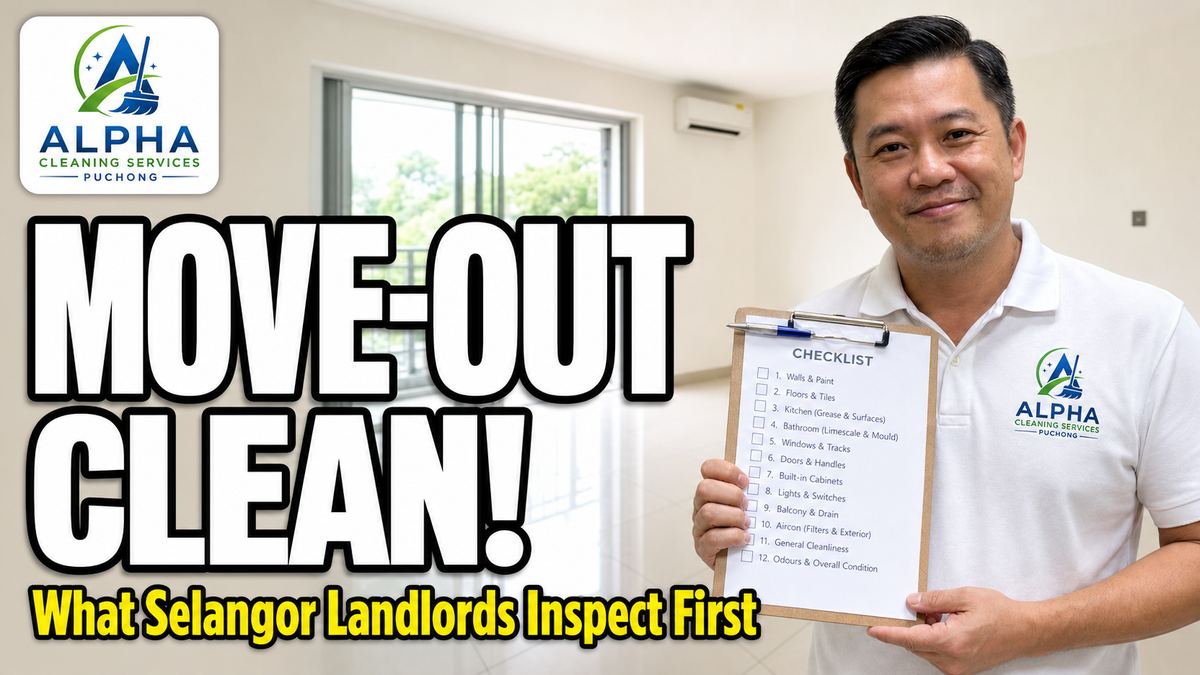

Almost every owner who's just finished a renovation in Puchong, Bandar Kinrara or Setia Walk says the same thing on the phone — "The contractor said they'd do a final clean, but the place still feels dusty." They're not wrong. A contractor's "final clean" is a sweep-and-mop. The dust they leave behind is a different category entirely.
Renovation dust isn't normal household dust. It's a mix of cement particulate, drywall powder, paint mist, varnish residue and timber sawdust — most of it small enough to drift back onto every surface for two weeks after the work ends. A regular weekly clean doesn't remove it; it just rearranges it.
Why Your Final Clean Still Feels Dusty
Three reasons:
- Cement haze chemically bonds to tile and glass. The fine particulate from grouting work creates a dull film that wet-mopping with detergent will not lift. It needs an acidic descaler (or a specific cement-haze remover) plus a microfibre rather than a sponge.
- HVAC and air-con systems redistribute trapped dust for weeks. The dust that sat on top of cabinets and inside ceiling cornices gets stirred up every time the AC turns on, falling back onto freshly cleaned surfaces.
- Varnish and paint VOCs cling to fabric. Curtains, sofa cushions and mattress fabric absorb the smell. No amount of mopping addresses it — they need to be steam-cleaned or aired out properly.
Wait at least 7 days after the last paint coat dries before scheduling a final post-reno clean. Earlier than that, dust is still actively settling and you'll end up paying twice. Two weeks is ideal in Klang Valley humidity.
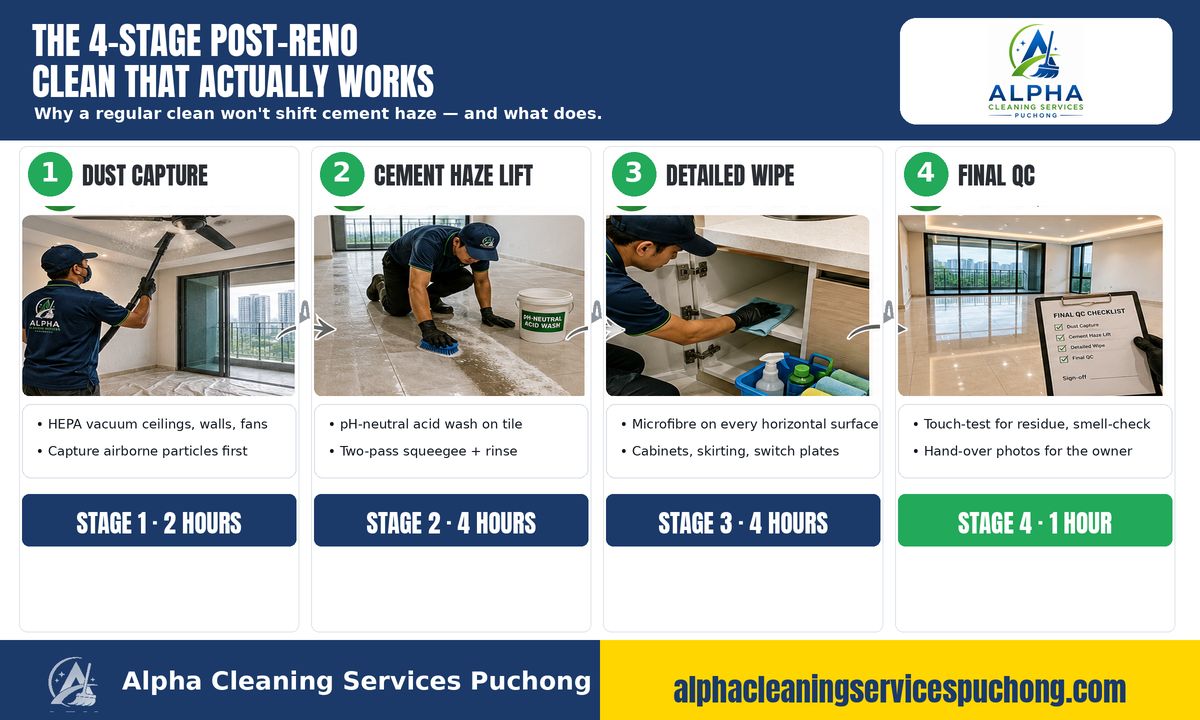
The Four-Stage Cleaning Sequence That Works
This is the sequence we run on every post-renovation cleaning job. Skipping any of the four stages leaves residue that surfaces within a week.
Stage 1 — Bulk Debris & Dry Vacuum
Bagging, sweeping and HEPA vacuuming. Every horizontal surface from ceiling fan blade tops down to skirting boards. We use a vacuum with a HEPA filter — a regular shop-vac just blows the fine particulate back into the air through the exhaust.
Special attention: top of door frames, top of wardrobes, behind freshly-installed kitchen cabinets, ceiling cornice ridges, AC indoor unit casing, exhaust fan grilles.
Stage 2 — Cement Haze & Paint Removal
This is the stage most "regular cleans" skip entirely. Cement haze removal needs a phosphoric or sulfamic descaler applied with a microfibre, dwell time of 3–5 minutes, then neutralised with clean water. Paint splatter on glass and tiles comes off with a plastic scraper at a 30-degree angle — never metal, which scratches.
Floors get wet-vacuumed twice — once with descaler, once with clean water. A regular mop just spreads the haze around.
Stage 3 — Detail & Surface Wipe-Down
Every surface gets a wipe with a damp microfibre — not just visible counters. Inside cabinet shelves, drawer interiors, wardrobe rails, all door fronts, all window sills. This is the slow stage. For a 1,200 sqft unit it takes one cleaner three full hours.
Glass surfaces get cleaned twice — first pass with a streak-free glass cleaner, second pass dry-buffed. Mirrors and shower glass need this for the dotted limescale-and-cement haze pattern to fully clear.
Stage 4 — Air, Fabric & VOC Reset
Curtains and sofa fabric absorb the renovation smell — they need either a steam-clean on site or an off-site dry-clean. We typically steam-clean in place; for very strong solvent smells we recommend dry-cleaning.
Air-con servicing isn't part of a standard clean, but the indoor unit louvres and filter need a wash — they accumulate the most fine particulate during a renovation. We do this; full chemical-wash service is a separate booking.
The advice that vinegar removes cement haze gets repeated in DIY blogs constantly. It's wrong on natural stone (etches the surface) and weak on glazed tile (works only on the lightest film). For anything more, you need a proper cement-haze remover. Test on a hidden tile first.
How Long It Actually Takes
For a 1,000–1,200 sqft Puchong condo after a full renovation:
- Stage 1 (debris & vacuum): 2 hours, 2 cleaners
- Stage 2 (cement haze & paint): 2.5 hours, 2 cleaners
- Stage 3 (detail & surface): 3 hours, 2 cleaners
- Stage 4 (air & fabric): 1.5 hours, 1 cleaner
Total: a long day with two cleaners, or a split across two consecutive days. Anyone quoting "5 hours, one cleaner" for a post-reno job is doing a regular deep-clean and labelling it post-reno.
When To Schedule
Three checkpoints before booking:
- Final paint coat fully dry, ideally 7 days settled.
- All contractor tools and bags removed from the unit. Otherwise the cleaners spend half their time clearing debris that should already be gone.
- Water and electricity confirmed working. No dry vacuuming a unit with no power, no descaling without running water.
If you'd like a flat ringgit quote with the four-stage scope listed line-by-line, send a photo of one finished room and the floor plan via WhatsApp. We'll come back within 30 minutes with the team size, the time window and a fixed price.
Just Finished Renovating?
Tell us your unit size and renovation scope — we'll quote a proper four-stage post-reno clean. Flat ringgit, no surprises.
WhatsApp For Post-Reno Quote