Every week we clean condos in Bandar Puteri Puchong, Puchong Jaya and IOI Resort City where at least one resident has a cat, a dog, or a pair of birds. The products left under the kitchen sink in most of these units — floor cleaners, toilet bowl drops, bathroom sprays — carry ingredient lists that veterinary toxicology advisories have flagged for years. The problem is not dramatic; pets do not drop immediately. The damage is cumulative: paw contact with mopped floors, nose-level vapours from tile cleaners, and grooming off residue left on surfaces.
Here is what to pull from your cleaning cabinet, what to replace it with, and how the Alpha team handles product selection when we clean a Puchong home with pets on-site.
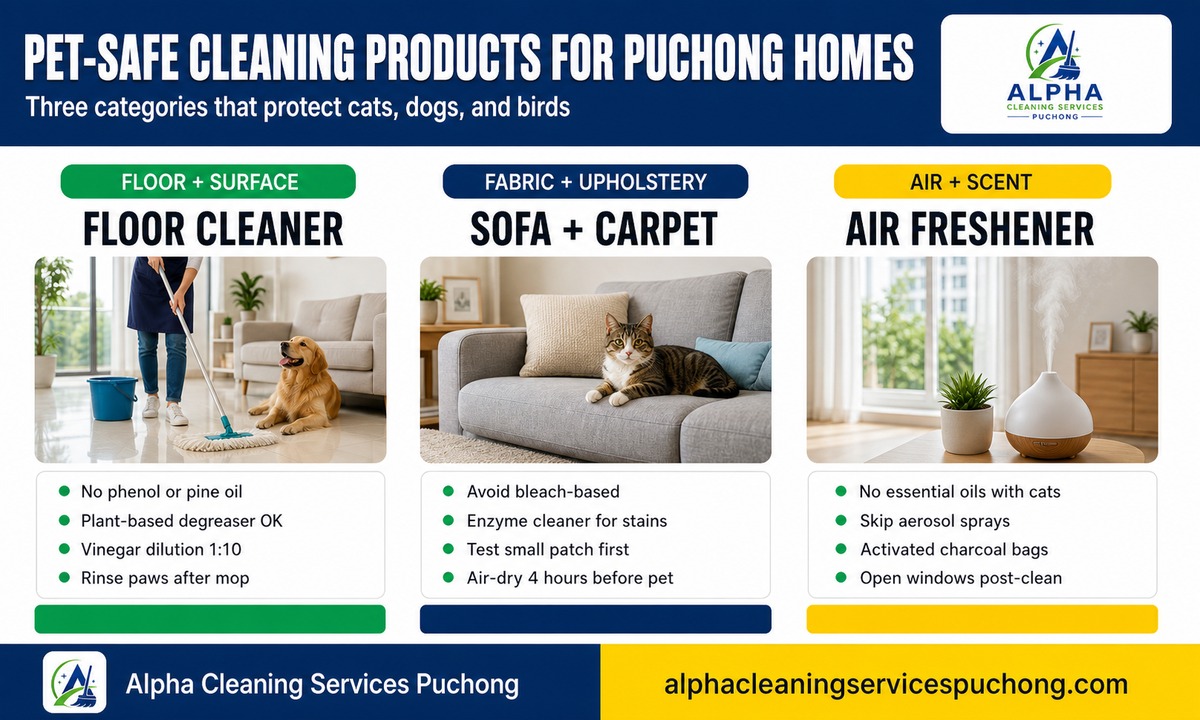
The three ingredient categories to remove immediately from a pet home: phenols/pine oil (found in most pine-scented floor cleaners), ammonia (glass and multi-surface sprays), and aerosol air fresheners with essential oils (acutely dangerous to caged birds and cats). Safe substitutes — white vinegar dilution, plant-based enzyme cleaners, baking soda pastes — are all available at Daiso IOI Mall Puchong, Mr DIY Tesco Puchong Jaya, and AEON Big Bukit Puchong.
Why Puchong Pet Owners Need To Rethink Cleaning Products
Klang Valley humidity keeps floor surfaces damp longer than a well-ventilated home in a drier climate. In a Puchong condo with the windows half-closed and the air-con running, a mopped floor takes 20–40 minutes to fully dry — long enough for a cat that walks across it to pick up a meaningful amount of residue on its paws, then groom it off. Dogs lick skirting boards. Birds in open-top cages breathe whatever is airborne at waist height and below. The exposure routes are real and frequent.
The second factor is product labelling. Most floor cleaners sold in Malaysia carry no explicit pet-safety warning on the front label. You have to read the full ingredient list — and even then, manufacturers are not required to list individual fragrance components, some of which are the actual hazard. The safest approach is to avoid product categories with known risk profiles altogether rather than trying to parse individual labels.
If you use a professional deep-cleaning service, ask explicitly what products they use around pets. Alpha uses enzyme-based and plant-derived formulations on all pet-household jobs by default.
Dangerous Chemicals Hidden In "Standard" Floor Cleaners
Three chemical categories account for the majority of pet-cleaning product incidents in Malaysian households. All three appear in products commonly stocked at Tesco, AEON and Econsave Puchong.
Phenols and Pine Oil
Phenol-based compounds are the active ingredient in most pine-scented floor cleaners — the category that smells like "clean" to most Malaysian households. Brands in this class include several products sold under white-label house brands at supermarkets. Cats metabolise phenols very poorly because they lack a specific liver enzyme (glucuronyl transferase) that most other mammals use to break down these compounds. Even brief repeated exposure — paw contact on a freshly mopped floor two or three times a week — can lead to cumulative hepatotoxicity. Dogs tolerate phenols better than cats but are not immune, particularly small dogs with high surface-area-to-body-weight ratios.
How to identify them on the label: look for phenol, cresol, xylenol, pine oil, o-benzyl-p-chlorophenol, or any variant of "pine extract" in the active ingredients section. If the label just says "fragrance" and the product smells of pine, treat it as suspect.
Ammonia
Glass cleaners and many multipurpose spray bottles rely on ammonia as the active cleaning agent. The respiratory irritation risk for birds is acute — even low ambient concentrations cause airway inflammation in budgerigars, cockatiels and lovebirds, species commonly kept in Puchong condos. Cats are also sensitive to ammonia vapours because the compound mimics the smell of urine, triggering stress responses and sometimes marking behaviour. Dogs with flat faces (pugs, bulldogs) are more susceptible than long-nosed breeds due to reduced nasal filtering. Standard glass cleaner sprayed on a mirror or window in a small bathroom with a bird or cat present creates a real inhalation hazard.
Bleach and Chlorine-Based Cleaners
Diluted sodium hypochlorite (bleach) is widely used for toilet bowls and bathroom tiles in Malaysian homes. At standard consumer concentrations it is irritating rather than acutely toxic for cats and dogs, but the chlorine gas released when bleach contacts ammonia (from urine, especially in litter boxes) creates a genuinely dangerous vapour. Never use bleach in or near a litter box area. The residual wet-surface risk is lower than phenols but not zero — rinse thoroughly and ventilate before allowing pet access.
| Cleaner Type | Cat Safety | Dog Safety | Bird Safety |
|---|---|---|---|
| Pine-scented floor cleaner (phenol/pine oil) | High risk — cumulative liver toxin | Moderate risk | Moderate risk |
| Ammonia glass / surface spray | Moderate — stress + airway | Low–moderate | High risk — acute respiratory |
| Bleach (diluted, rinsed) | Low if rinsed; high near litter | Low if rinsed | Moderate — chlorine vapour |
| Aerosol air freshener with essential oils | High risk — especially tea tree | Moderate | Very high — airborne concentration |
| White vinegar (5% dilution) | Safe | Safe | Safe |
| Plant-based enzyme cleaner | Safe | Safe | Safe |
| Baking soda paste | Safe | Safe | Safe |
Pet-Safe Floor + Surface Alternatives
The good news is that the safest alternatives are also the cheapest, and all are stocked locally in Puchong.
White Vinegar Dilution — The Daily Floor Solution
A 1:10 solution of white vinegar in water (roughly half a cup of vinegar per bucket of water) cleans sealed tile, vinyl plank, and porcelain floors effectively, cuts light grease, and leaves no residue dangerous to pets. At Daiso IOI Mall Puchong or the Daiso in Setia Walk, a 500ml bottle of white vinegar costs RM 5.90. For an entire Puchong condo floor, you need less than RM 2 per mop. The smell dissipates within 10–15 minutes once the floor dries — faster than most pine cleaners, which leave a chemical odour that lingers in Klang Valley humidity.
Vinegar is not suitable for marble or natural stone — the acidity etches the surface. For marble-look tiles (common in Bandar Puteri Puchong newer blocks), use a pH-neutral plant-based cleaner instead.
Plant-Based Degreasers
For kitchen grease and bathroom soap scum, a surfactant-based plant-derived degreaser outperforms vinegar without the phenol risk. Look for products listing sodium lauryl glucoside, decyl glucoside, or cocamidopropyl betaine as the active ingredients — these are plant-derived and break down rapidly. The Ecover range (available at Village Grocer IOI City Mall, about 15 minutes from central Puchong) and the local Bumi brand are both in this category. Mr DIY Tesco Puchong Jaya carries several affordable plant-based sprays under RM 12 per bottle.
Enzyme Cleaners for Pet Accident Areas
Enzyme-based cleaners — the same category used professionally for carpet cleaning and mattress cleaning — are the correct tool for urine and faecal residue from pets. They digest the organic compound rather than masking it with fragrance, which also prevents re-marking. The Nature's Miracle range and the local BioZyme formulation are both safe for cats, dogs and birds at the dilutions on the label. AEON Big Bukit Puchong and PetWorld IOI Mall both stock enzyme cleaners in the RM 18–28 range per bottle.
Sofa, Carpet and Mattress: What's Safe Around Pets
Upholstery cleaning is where the risk profile shifts, because most standard carpet shampoos and upholstery sprays are formulated for humans-only spaces and use fragrance-masking agents that contain the same phenolic compounds as pine floor cleaners.
For sofas and fabric upholstery, a diluted plant-based dish soap (Sunlight or Fairy, both widely available in Puchong) applied with a damp cloth handles light soil without chemical risk. For deeper cleans — pet hair embedded in fabric, urine that has penetrated the foam — a steam extraction clean using an enzyme pre-spray is the correct approach. This is what the Alpha team uses on pet-household sofa cleaning jobs. The steam itself sanitises without chemicals; the enzyme pre-spray breaks down any organic residue before extraction.
For mattresses in a home with pets allowed on the bed, monthly enzyme spray treatment and a quarterly professional steam extraction is a practical schedule. Baking soda — spread across the surface, left for 30 minutes, vacuumed off — is safe for all pets and removes light odour between professional cleans.
Air Fresheners — The One Category To Eliminate Entirely Around Cats and Birds
Aerosol air fresheners are the highest-risk cleaning-adjacent product in a pet home, and the most overlooked. The risk is concentrated in two sub-types: products containing essential oils, and standard aerosol sprays used in enclosed or poorly ventilated rooms.
Essential Oils and Cats
Tea tree, eucalyptus, lavender, peppermint, cinnamon and citrus oils are all hepatotoxic or neurotoxic to cats at relevant exposure levels. This applies to reed diffusers, plugin diffusers, spray-on fabric fresheners, and scented candles with essential oil content — not just direct application. A diffuser running in a 700 sqft Puchong studio with one cat and the air-con recirculating is a meaningful exposure risk over weeks and months. The cat does not have to chew or lick the product; inhalation and surface deposition on fur (then groomed off) is the route.
For birds — budgerigars, cockatiels, African greys — any aerosol spray in the same room is a risk. Birds have highly efficient respiratory systems evolved for thin mountain air; this means airborne particles and volatile compounds reach the lower airways at concentrations that do not affect mammals in the same space. Non-stick cookware (PTFE) fumes, scented candles, and aerosol sprays have all caused avian fatalities documented by veterinary toxicologists. The rule for bird households is simple: no aerosols in any room the bird has access to, and adequate cross-ventilation when using any spray product in adjacent rooms.
Safe Alternatives for Odour Control
Open ventilation is the only truly safe odour control for a bird household. For cat and dog households, activated charcoal sachets (Daiso Puchong IOI, RM 5.90 for a pack) absorb odour without releasing anything into the air. Baking soda in an open dish near the litter box area does the same. A HEPA air purifier — in the RM 200–400 range at Harvey Norman IOI City Mall — handles pet dander and ambient odour without any chemical input.
The Alpha Pet-Safe Cleaning Protocol
When we receive a booking from a Puchong household that mentions pets, we default to the following product set regardless of what is already under the sink:
- Floors: white vinegar or pH-neutral plant-based cleaner (marble/natural stone areas). No pine cleaners, no phenol-containing products.
- Bathrooms: citric acid-based descaler for tiles and glass; baking soda paste for grout; plant-based spray for surfaces. Bleach only in toilet bowls, thoroughly rinsed, pets out of the room for 30 minutes minimum.
- Kitchen: plant-based degreaser for cooktop, range-hood, cabinet fronts. No ammonia-based sprays.
- Upholstery and carpets: enzyme pre-spray + steam extraction for sofas, carpets, and mattresses. No chemical fragrance application post-clean.
- Air: no aerosols or air fresheners deployed. Windows open or air-con on fresh-air mode during and for 30 minutes after the clean.
If you want a specific product list for your own regular maintenance cleaning between professional visits, WhatsApp us your unit type and pet situation and we will send a typed-out shopping list specific to what is available at Tesco Puchong Jaya, Mr DIY Puteri Mall, Daiso IOI Mall, or AEON Bukit Puchong — whichever is closest to you.
Need A Pet-Safe Deep-Clean For Your Puchong Home?
Tell us your pets and unit size on WhatsApp. We will confirm our product list before arrival and quote a flat ringgit price — no deposit, no surprises.
WhatsApp For A Pet-Safe Quote