Dato Loke's 4-bed terrace in Bukit Kuchai houses a family of 6 — two working parents, three school-age children, and a grandmother who lives in full-time. With the house running at full capacity seven days a week, he wanted a set-and-forget quarterly contract with the same team arriving every 12 weeks — no rebooking, no explaining preferences from scratch, no surprises.

When a household runs seven days a week — school bags, a grandmother's daily cooking, weekend guests, children's bedrooms accumulating the usual chaos — a standard one-off deep-clean every few months is just catching up. Dato Loke wanted something different: a structured quarterly rhythm where the same team shows up, knows the house, and handles everything without a single WhatsApp to explain what's behind the master-bedroom wardrobe.
Dato Loke found Alpha via a Google search after a previous cleaning company sent a different crew on their third booking — new faces who asked the same questions about where the mop bucket was kept, which surfaces were marble, and whether the grandmother's room needed special handling. He'd had enough of re-explaining.
His requirement was simple: one team, locked in, four times a year. The same three people who learn the layout, the preferences, the sensitive areas, and build up a working knowledge of a house that holds two generations under one roof. He also wanted mattress cleaning and sofa cleaning included in every quarterly visit — not as add-ons he'd have to book separately.
We quoted the full contract: four visits at a fixed price per visit, invoiced quarterly, same team assigned. He signed off the same day.
Sending a different crew to a family home every few months creates a recurring cost that most customers don't account for: the orientation cost. A new team spends 20–30 minutes getting their bearings, asking permission questions, and treading carefully around areas they're unsure about. A team that knows the house can start the full-speed sequence within 10 minutes of arrival.
There's also an accountability dynamic that changes when the same people return. When Ariff's team finished visit 1 and knew they were coming back in 12 weeks, the standard of handover was different — the kind of standard you apply when you know you're going to see the results of your own work again, not hand it off anonymously.
Preference learning compounds over visits too. By visit 2, Ariff's team had noted that Dato Loke's mother prefers no strong chemical smells in her room — they shifted to a fragrance-free product on her surfaces. By visit 3, the team knew the two kids' rooms generated the heaviest bedroom load and front-loaded that time. By visit 4, the deep-clean sequencing had been fine-tuned to the exact flow of a 1,800 sqft terrace with a ground-floor wet kitchen, a first-floor dry kitchen, and a grandmother's annexe bedroom at the rear of the ground floor.
None of that is possible with rotating crews from a general booking pool.
Each 12-week visit runs the same structured 8-hour sequence across three cleaners — a format that holds whether the house has had a calm quarter or a chaotic one. The scope per visit:
The team arrives at 9am and completes by 5pm. Dato Loke or his wife does a walk-through with Ariff before the team leaves — any items flagged are addressed on the spot or noted for the next visit's priority list.
Visit 1 at a new house with a full family in residence is the heaviest. The team is cataloguing as well as cleaning: which surfaces are sensitive, what's the grandmother's room layout, where is the utility cabinet, which bathroom is the highest-traffic one. The clock runs slightly slower on visit 1 because of this overhead.
By visit 4 — twelve months in — the dynamic had shifted substantially. The Bukit Kuchai terrace had accumulated less between visits because the quarterly resets had broken the build-up cycle. The family had quietly stopped doing the weekend DIY mop-and-wipe sessions they'd been maintaining between previous irregular cleanings. The kids' bedrooms — which had required a full declutter-then-clean sequence on visit 1 — were maintained at a higher baseline by the children themselves, partly because they'd seen the cleaned version four times now and associated it with how the room was supposed to look.
One data point Dato Loke mentioned in a WhatsApp update after visit 3: his youngest child had fewer respiratory flare-ups in the second half of the year compared to the first. He didn't attribute it solely to the mattress steaming — but he noted the correlation. We note it too, without overclaiming.
The cleaning output on visit 4 was the same 8 hours and same scope as visit 1. The result felt more polished because the baseline was higher. That's the compounding effect of a sustained rhythm.
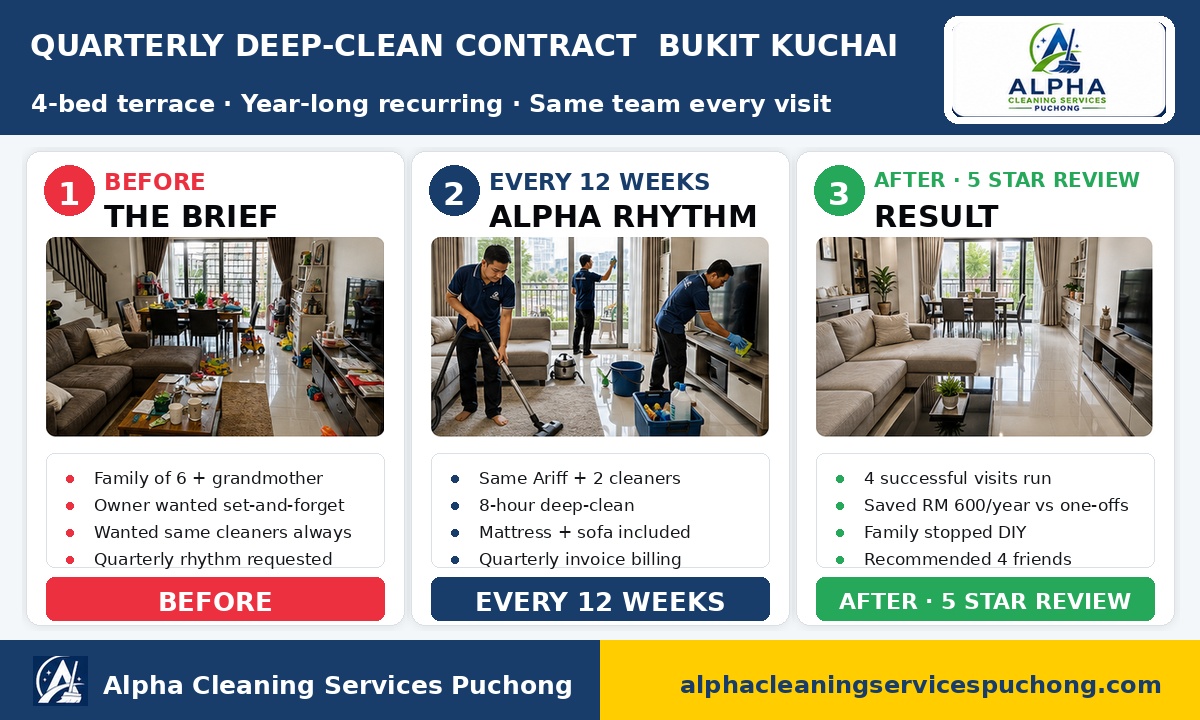
After 12 months and 4 completed visits, Dato Loke renewed. The reasons he gave us when we asked were straightforward:
For larger family homes in Puchong — particularly 4-bed and above with multiple generations in residence — a quarterly contract isn't just a convenience product. It's a structurally better way to maintain a house that a rotating one-off booking model can never replicate. The muscle memory, the accountability, and the preference learning only accumulate if the same team keeps coming back. If that model fits your household, read our guide on cleaning frequency then send us a WhatsApp — we'll structure the right visit cadence for your setup.
We have six in the family plus my mother — the house gets heavy use. Signing up for Alpha's quarterly contract was the best decision we made. Same team every visit, they already know the house. We've saved roughly RM 600 compared to booking one-offs, and I've already recommended them to four neighbours.
Tell us your area, house size, and how often you need a reset — we'll quote a contract rate and lock in your team same day.
WhatsApp For A Contract Quote
WhatsApp us your address and what needs cleaning. Quote in under 30 minutes — flat ringgit, no surprises.